
Have you ever come across a word like “unhappy” or “preheat” and wondered, “Wait, what does that little ‘un-’ or ‘pre-’ at the start mean?” That’s exactly how I felt the first time I saw the term prefix in my grammar class. I stared at the page, confused, until someone explained it in the simplest way. It turns out, understanding prefixes is easier than it seems and can make your reading and writing much more fun!
Prefix means “a group of letters added at the beginning of a word to change its meaning.” It’s a friendly and simple way to modify words and make your sentences more precise.
🧠 What Does “Prefix” Mean in Text?
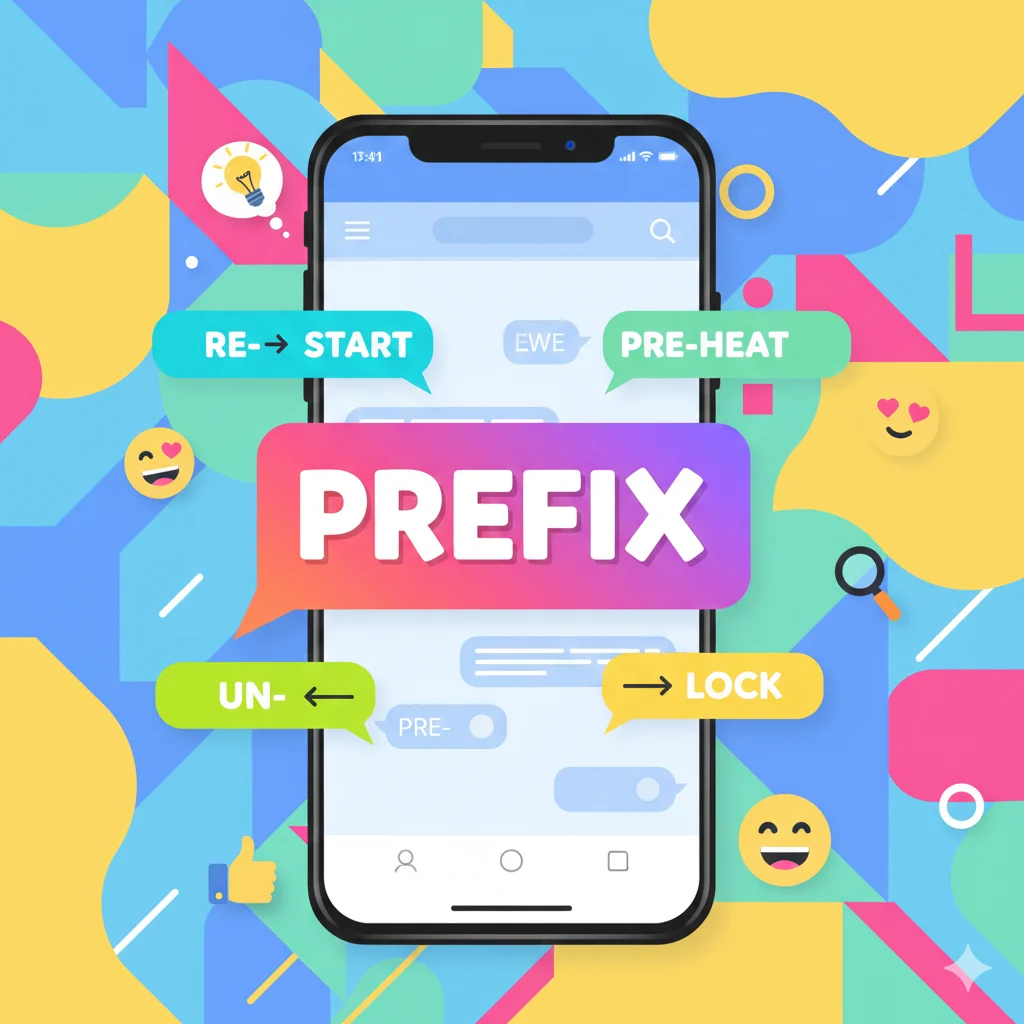
A prefix is a set of letters placed before the root of a word to create a new word with a different meaning. For example:
- Un + happy = Unhappy → not happy
- Pre + heat = Preheat → heat beforehand
It’s a small change that can completely alter the meaning of a word.
Example in a sentence:
“I need to rewrite my essay before submission.”
Here, “re-” is a prefix meaning “again,” so “rewrite” means “write again.”
In short: Prefix = letters added at the start of a word = changes the meaning of the word.
📱 Where Is “Prefix” Commonly Used?
Prefixes aren’t just for textbooks—they pop up everywhere:
- 📚 Education & Writing — spelling, grammar, and language learning
- 💬 Texting & Social Media — abbreviations like pre- in pre-order, re- in reply
- 🖥 Emails & Professional Writing — formal prefixes like “co-” (co-founder) or “ex-” (ex-president)
- 🎮 Gaming & Online Chats — short forms using prefixes like “un-” for undo actions
Tone & Style: Mostly educational or casual, but can also appear formal in professional writing.
💬Examples of “Prefix” in Conversation
Here are some chat examples showing how prefixes appear in daily texting or social media conversations:
A: Did you pre-order the new game?
B: Yup! Can’t wait 🎮
A: I feel unhappy about the results 😢
B: Don’t worry, it happens to everyone
A: Can you redo the assignment?
B: Sure, I’ll rewrite it tonight ✍️
A: Are you replaying the match?
B: Yes, I want to see that goal again ⚽
A: He’s the ex-CEO, right?
B: Yes, he retired last year 🏢
Estimated Student Aid Index (SAI) -1500 Mean: Unlock the Secret Formula Today
🕓 When to Use and When Not to Use “Prefix”
✅ When to Use:
- When learning or teaching English
- When writing or editing texts
- When explaining meanings of words
- In casual chats about words or spelling
❌ When Not to Use:
- In formal legal documents without context
- When clarity is crucial, and the full word is better
- In urgent messages where prefixes may confuse
Comparison Table:
| Context | Example Phrase | Why It Works |
|---|---|---|
| Friend Chat | “That’s unbelievable 😂” | Casual & fun |
| Work Chat | “Please recheck the report” | Polite & professional |
| “Kindly pre-review the document” | Formal & clear |
🔄 Similar Slang Words or Alternatives
| Slang/Term | Meaning | When to Use |
|---|---|---|
| Suffix | Letters added at the end | Word building in writing |
| Abbreviation | Short form of a word | Texting & notes |
| Root word | Base form of a word | Vocabulary learning |
| Compound | Two words combined | Everyday writing |
| Prefix+Suffix | Combination of both | Grammar practice |
📝 Tips for Using “Prefix” Like a Pro
- Start with common prefixes: un-, re-, pre-, mis-
- Practice by breaking words into root + prefix
- Use in texting for fun words: redo, pregame, replay
- Avoid overcomplicating sentences with too many prefixes
- Notice prefix usage in ads and social media
📊 Common Mistakes People Make With “Prefix”
- ❌ Confusing un- and in- → “unpossible” instead of “impossible”
- ❌ Double prefixes → “reredo” (should be just redo)
- ❌ Using prefixes with wrong root words → “preknow” (doesn’t exist)
- ✅ Tip: Always check if the combination exists in standard English
🧩 Fun Facts About “Prefix”
- Prefixes have been used since ancient Latin and Greek times
- Some prefixes can completely change meaning, e.g., “inflammable” vs “flammable”
- In digital age, prefixes are everywhere—pre-save, rewatch, unfriend
- Using prefixes creatively can make texts shorter and trendier
❓ FAQs About “Prefix”
- What is a prefix in simple words?
A prefix is letters added to the start of a word to change its meaning. - Can every word have a prefix?
No, only some words can be modified with prefixes like “un-,” “re-,” or “pre-.” - Is prefix formal or casual?
It depends—educational and professional writing is formal, but prefixes also appear casually in texting. - How do I remember prefixes?
Learn common ones like un-, re-, pre-, mis-, co- and practice using them in sentences. - Are prefixes the same as suffixes?
No, prefixes go at the beginning, suffixes at the end of a word. - Can I use prefixes in social media?
Yes! Words like “pre-save,” “repost,” or “unfollow” use prefixes all the time.
✅ Conclusion
Prefixes are small but powerful tools in English. They help you change word meanings, write concisely, and even text creatively. From casual social media messages like “repost” or “preorder” to formal writing like “co-founder,” understanding prefixes makes communication smoother and more precise. Start spotting prefixes today, and you’ll notice your reading and texting skills improve instantly!

Charles Dickens was a legendary English novelist and social commentator known for his timeless storytelling and deep understanding of human nature. His works continue to inspire writers and readers worldwide, shaping literature, culture, and modern narrative craft.