
I’ll never forget the first time I saw “proctored exam” on a course syllabus. My heart did a little flip. It sounded so official, so intimidating—like something involving a stern judge and a courtroom rather than my pajamas and a laptop. Was I being watched? Were they going to record me? A million questions raced through my mind, and I immediately went down an internet rabbit hole trying to figure out what I was in for. If you’ve landed here with that same knot in your stomach, don’t worry. You’re not alone, and we’re about to demystify this whole thing together.
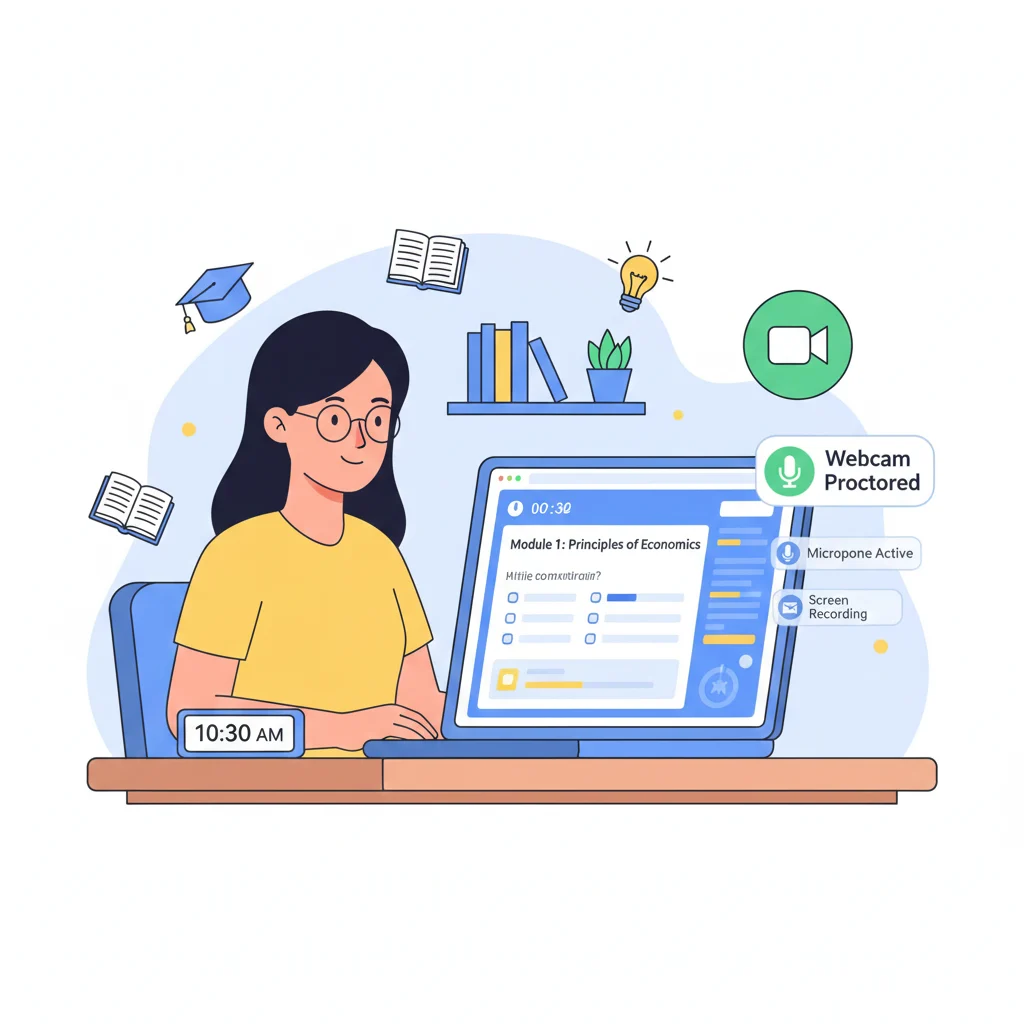
“Proctored” means supervised or invigilated. In the context of online tests, a proctored exam is one that is monitored by a person or software to ensure academic integrity and prevent cheating.
🧠 What Does Proctored Mean in an Online World?
So, let’s get to the heart of it. The term “proctored” is an adjective that comes from the word “proctor,” which is simply a fancy name for a supervisor or an invigilator—the person who walks around the room during a traditional exam to make sure no one is peeking at their neighbor’s paper.
In the digital age, this role has evolved. A proctored exam is any test, quiz, or assessment that is monitored to uphold honesty and fairness. The core goal is to replicate the oversight of an in-person classroom in a virtual environment. This means ensuring the right person is taking the test, that they aren’t using unauthorized resources, and that they are following the exam rules.
In short: Proctored = Supervised = A monitored test designed to prevent cheating.
📱 Where Are Proctored Exams Commonly Used?
You’re most likely to encounter proctored exams in formal, academic, or professional certification settings. It’s not the kind of thing you’d see on a casual social media quiz about “Which Disney Character Are You?”
Here’s where you’ll find them:
- 🎓 Online University Courses: Schools like Arizona State University, Southern New Hampshire University, and massive open online course (MOOC) platforms like Coursera and edX use them for crucial midterms and finals.
- 📜 Professional Certification Exams: Think high-stakes tests for credentials like the CPA (Certified Public Accountant), PMP (Project Management Professional), or IT certifications from CompTIA.
- 🏫 Standardized Testing: Some at-home versions of exams like the GRE, GMAT, or even certain high school equivalency tests are proctored.
- 💼 Corporate Training & Hiring: Some companies use proctored assessments during the hiring process or for internal compliance training to ensure employees are genuinely learning the material.
The tone here is formal and serious, not casual or social-media-friendly. It’s all about maintaining trust and credibility.
What Does Cheek Acne Mean? The Surprising Text Slang Explained 💬🔍
👁️ How Does Online Proctoring Actually Work?
This is where it gets interesting. How can someone watch you through a computer screen? There are generally three methods of online proctoring:
- Live Online Proctoring: A real, human proctor watches you in real-time through your webcam. They can see you, your screen, and your surroundings. They may intervene via chat or audio if they see a rule violation.
- Recorded Proctoring: The software records your webcam, microphone, and screen during the entire exam. A human proctor then reviews the recording after you’ve finished to flag any suspicious activity.
- Automated Proctoring (AI Proctoring): This is the most common method for many institutions. An Artificial Intelligence program monitors your exam session. It uses your webcam to track your eye movements, head position, and background noise. If it detects potential red flags (like you looking off-screen too often or hearing another voice), it flags the incident for a human to review later.
Common Proctoring Software & Technologies:
- ProctorU
- Examity
- Proctorio
- Honorlock
- Respondus Monitor
💬 Examples of Proctored Exam Rules & Scenarios
Let’s look at how this plays out in realistic scenarios, from the initial announcement to the exam room itself.
Example 1: The Syllabus Announcement
Professor: “The final exam will be proctored using Proctorio. You must have a webcam and a stable internet connection. Please review the proctoring guidelines on the course portal.”
Student in Group Chat: “ugh, a proctored final? that means i have to clean my room for the webcam 😩”
Example 2: The Pre-Exam Checklist
Software Prompt: “Before we begin, we need to perform a system check. Please show your ID to the webcam. Now, slowly pan your webcam around your room to show your workspace.”
You: [Slowly shows your desk, walls, and door to the camera] “Okay, hope they don’t judge my boring walls.”
Example 3: The “No Unauthorized Materials” Rule
AI Proctor Flag: Flag Raised: Potential unauthorized material. Student looked down and to the left for an extended period.
Review Note: “It was just my dog walking into the room! I was looking at him, not a cheat sheet.”
Example 4: The “No Talking” Rule
Rule: “You must not speak aloud during the exam unless instructed by the proctor.”
What happens if you do: The AI detects unexpected audio and flags your session. A live proctor might pop up with a text warning.
✅ When to Use and When Not to Use Proctored Exams
Understanding the context for proctoring is key for both students and educators.
✅ When Proctoring is Appropriate:
- High-Stakes Academic Exams: Finals, midterms, or any exam that carries a significant portion of the final grade.
- Professional Licensure Tests: Where public safety or professional standards are on the line (e.g., medical, legal, financial certifications).
- Entrance Exams: For universities or competitive programs where integrity is paramount.
- Ensuring Credibility: For any online program that needs to prove its degrees and certificates are earned honestly.
❌ When Proctoring is Unnecessary or Overkill:
- Low-Stakes Quizzes or Practice Tests: Where the primary goal is learning, not assessment.
- Informal Knowledge Checks: In a corporate training module that isn’t graded.
- Situations Based on Trust and Honor: Some professors and institutions prefer an honor system, especially for smaller, discussion-based classes.
- When Access to Technology is a Barrier: Not all students have a reliable webcam, microphone, or high-speed internet.
Proctoring Context Table
| Context | Example Phrase | Why It Works / Doesn’t Work |
|---|---|---|
| University Final Exam | “This final is proctored to ensure academic integrity for all students.” | Essential for maintaining the value and fairness of the degree. |
| Workplace Software Quiz | “This training module ends with a short, un-proctored quiz to test your knowledge.” | The goal is learning reinforcement, not high-stakes judgment. |
| Professional Certification | “The CPA exam is a proctored test, available at testing centers or online.” | Legally required to protect the credential’s reputation. |
| Casual Book Club Quiz | “Take our fun, un-proctored quiz to see which character you are!” | Would be creepy and completely unnecessary. |
🔄 Similar Terms & Alternatives to Proctored Exams
It’s helpful to know the related lingo in the world of online assessment.
| Term | Meaning | When It’s Used |
|---|---|---|
| Invigilated | The British English equivalent of “proctored.” Means the exact same thing. | Commonly used in the UK, Canada, Australia, and other Commonwealth countries. |
| Supervised Exam | A more straightforward synonym for “proctored exam.” | Often used in course descriptions to be more student-friendly and less jargon-heavy. |
| Unproctored Exam | An exam taken without any direct supervision. | Used for low-stakes tests, open-book assignments, or honor-system-based assessments. |
| Open-Book Exam | An exam where you are allowed to consult your notes, textbook, or other resources. | These can still be proctored! The proctoring ensures you’re not using unauthorized people or websites like Chegg. |
| Honor Lock | This is a specific brand name of proctoring software, but it’s often used generically. | “Is this test on Honorlock?” (Similar to how “Kleenex” is used for tissues). |
❓ FAQs About Proctored Exams
Let’s tackle some of the most frequently asked questions and common concerns.
1. Can you cheat on a proctored exam?
While it’s very difficult, people still attempt it. However, proctoring software is sophisticated and designed to detect cheating behaviors like eye movement anomalies, unusual keyboard activity, and background apps. The risk of getting caught—which often leads to a failing grade or even expulsion—is extremely high.
2. What happens if the proctoring software flags me by mistake?
This is a common fear. If the AI flags you (e.g., for a pet making noise or you muttering to yourself), a human proctor will review the recording. If the violation was clearly unintentional and minor, it’s often dismissed. Most institutions have an appeal process if you feel you were flagged unfairly.
3. Do I have to pay for a proctored exam?
Sometimes. The cost is often bundled into your course or exam fees. Some third-party proctoring services charge a separate fee directly to the student, but your institution will always make this clear upfront.
4. What are the biggest drawbacks of online proctoring?
The main concerns are:
- Privacy: You are essentially letting a company or person into your private space.
- Technical Issues: Glitches can cause major stress and potentially invalidate an exam.
- Accessibility & Bias: The software can sometimes unfairly flag neurodivergent individuals (e.g., those with ADHD who may fidget) or those who don’t have a “standard” testing environment.
- Test Anxiety: The feeling of being watched can significantly increase stress for some test-takers.
Conclusion:
Understanding what proctored means is the first step to feeling confident and prepared. While the idea of being monitored can be unnerving, it’s ultimately a tool to protect the value of your education and the credentials you work so hard to earn. The key is to see it not as a big brother-style invasion, but as a digital equivalent of a teacher walking quietly through the rows of desks during a final—a necessary step to ensure a level playing field for everyone.
So the next you see “proctored exam” on your syllabus, take a deep breath. Prepare your space, test your tech, and walk in knowing you’re ready to prove your knowledge honestly and successfully. You’ve got this

William Shakespeare was a legendary English playwright, poet, and storyteller whose works have shaped literature for centuries. Known for his timeless plays and sonnets, he continues to inspire writers, artists, and readers around the world with his mastery of language and storytelling.