
I’ll never forget the first time I heard the term “Rolex Oyster.” I was scrolling through a luxury watch forum, feeling completely out of my depth. People were throwing around words like “Oystersteel,” “Perpetual,” and “Oyster case” with such ease, while I sat there imagining a fancy seafood platter or perhaps a secret pearl hidden inside the watch. I was confused, a little intimidated, and utterly curious. If you’ve ever found yourself in the same boat, wondering what on earth this iconic term signifies beyond its literal meaning, you’ve come to the right place. Let’s crack open the shell and discover the true story behind the name that built a legend.
“Rolex Oyster” refers to the world’s first waterproof and dustproof watch case, invented by Rolex in 1926. It’s a technical and prestigious term describing the revolutionary hermetically sealed case that protects the watch movement, making Rolex synonymous with durability, reliability, and luxury.
🧠 What Does “Rolex Oyster” Actually Mean?
At its core, the term “Rolex Oyster” describes the foundational engineering breakthrough that made Rolex a household name. It is not a single watch model, but rather a type of case construction that is used on the vast majority of Rolex watches today. Think of it as the chassis of a high-performance car; it’s the protective shell that houses the intricate engine inside.
The name “Oyster” was chosen because, like the hard shell of an oyster that protects the precious pearl within, the Rolex Oyster case was designed to hermetically seal and protect the delicate watch movement from its external environment. This was a monumental achievement in the 1920s, when watches were highly susceptible to damage from moisture, dust, and shocks.
The key innovation lies in the case’s components:
- The Case Middle: The main body of the watch, machined from a single block of metal.
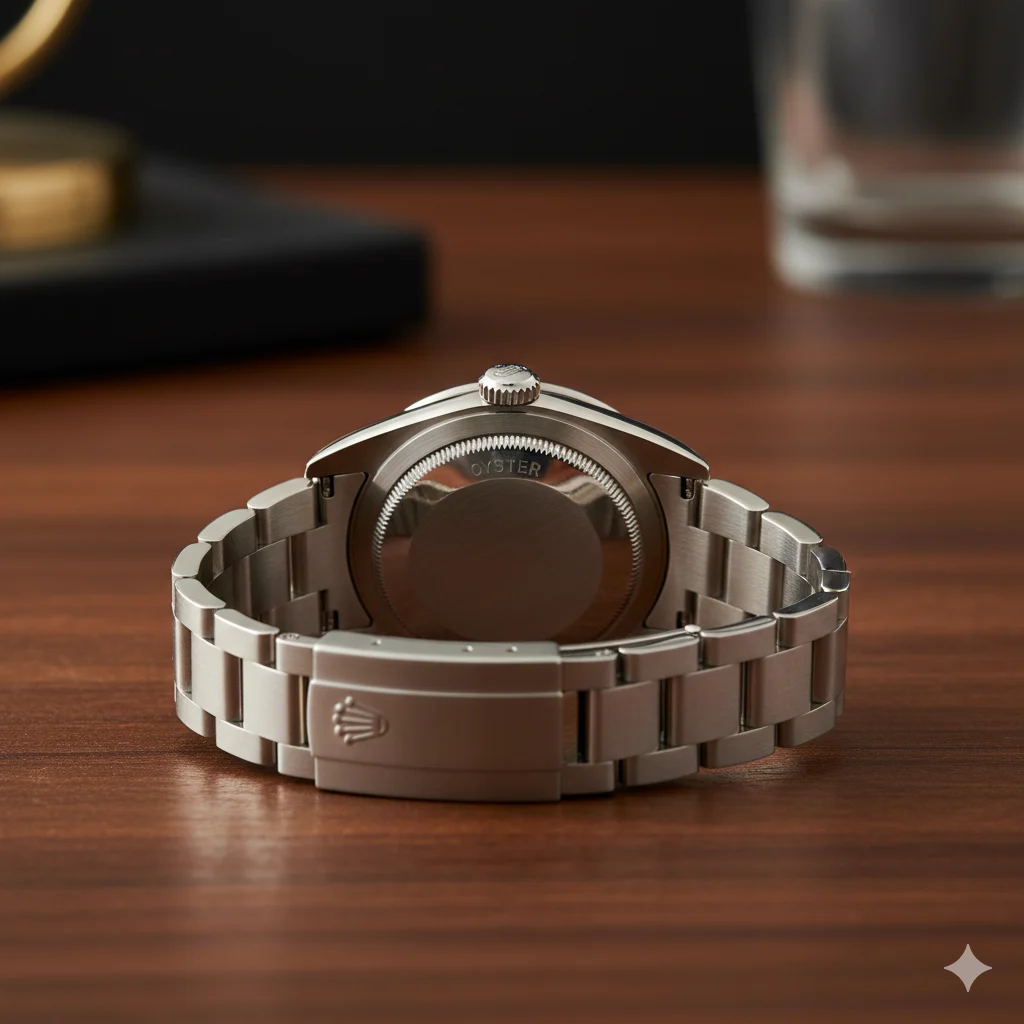
- The Screw-Down Case Back: Unlike watches that snap shut, the Oyster case back screws onto the case middle, creating an airtight seal.
- The Screw-Down Winding Crown: This was Rolex’s true stroke of genius. The crown, which you use to wind the watch and set the time, screws down directly onto the case tube, much like a submarine hatch, locking out water and dust.
In short: Rolex Oyster = A Hermetically Sealed Case = The foundation of Rolex’s reputation for robustness and reliability.
📜 The History Behind the Oyster Case
To truly understand what “Rolex Oyster” means, you have to appreciate its history. In the early 20th century, watch reliability was a major issue. Moisture, dust, and temperature changes could easily ruin a watch’s accuracy or stop it altogether.
The founder of Rolex, Hans Wilsdorf, was a visionary who dreamed of creating a truly reliable wristwatch. His breakthrough came in 1926 with the invention of the Oyster case. But an invention is nothing without proof. That proof came a year later, in 1927.
The Mercedes Gleitze Cross-Channel Swim: A young British secretary named Mercedes Gleitze attempted to swim across the English Channel. Rolex saw a perfect opportunity. They equipped her with an Oyster watch, which she wore around her neck during the grueling, more than 10-hour swim. When she emerged from the cold waters, the watch was not only still working but was keeping perfect time. Rolex took out a full-page ad on the front page of the Daily Mail to announce this triumph, and the legend of the Oyster was born. This single event cemented Rolex’s image as a maker of incredibly durable and trustworthy timepieces.
📱 Where Is the Term “Rolex Oyster” Commonly Used?
You’ll encounter the term “Rolex Oyster” in several key places, almost always within the context of luxury, horology, and style.
- 💼 Official Rolex Marketing & Website: This is the term’s home. Rolex uses “Oyster” consistently to describe the case of most of its watches (e.g., Oyster Perpetual, Submariner, GMT-Master II).
- 🏪 Authorized Dealers & Watch Forums: Salespeople and watch enthusiasts use the term to specify the type of case construction and to highlight the watch’s heritage and capabilities.
- 📰 Luxury & Lifestyle Magazines: Publications like GQ, Esquire, and Robb Report use “Oyster” when reviewing or featuring Rolex watches, assuming a level of reader knowledge.
- 💬 Pre-Owned & Auction Listings (Chrono24, Sotheby’s): The term is crucial for accurately describing a watch’s specifications and authenticity. A “Rolex Oyster” is a specific and important descriptor that affects value.
- ✍️ Social Media Watch Communities (Instagram, Reddit r/Watches): Enthusiasts and collectors use the term casually when discussing their watches, sharing photos (#OysterPerpetual), or asking for advice.
Tone & Context: The term is formal and technical within the watch world, but it carries a strong connotation of prestige, quality, and luxury. It’s not casual slang; it’s a key part of the Rolex brand identity.
⌚ The Key Components of a Rolex Oyster
When someone says “Rolex Oyster,” they are referring to a system. Let’s break down the critical parts of this iconic invention.
The Oyster Case Itself
The case is typically crafted from Rolex’s proprietary metals like Oystersteel (a highly corrosion-resistant 904L stainless steel), yellow, white, or Everose gold, or platinum. Its monolithic structure provides the first line of defense.
The Twinlock and Triplock Screw-Down Crown
The crown is the gateway to the watch’s movement. Rolex developed two sealing systems:
- Twinlock Crown: Identified by two dots beneath the Rolex crown emblem, this system uses two sealed zones and is used on cases waterproof to 100 meters.
- Triplock Crown: Identified by three dots, this system uses an additional third sealed zone and is used on professional dive watches like the Submariner and Sea-Dweller, guaranteeing extreme water resistance.
The Sapphire Crystal
The crystal covering the dial is made from virtually scratch-proof synthetic sapphire. It’s pressure-fitted into the case with a gasket to ensure the seal remains intact.
The Oyster Bracelet
While the case is the star, the Oyster bracelet is its perfect partner. Introduced in the late 1930s, it’s a three-piece link bracelet known for its robustness, comfort, and timeless aesthetic. It’s as iconic as the case itself and is a standard feature on most Oyster models.
💬 Examples of “Rolex Oyster” in Real Conversation
How does this term come up in everyday talk among watch lovers? Here are some realistic examples.
1. At the Authorized Dealer:
Customer: “I’m really interested in the new Air-King.”
Sales Associate: “Excellent choice. It features the iconic 40mm Oyster case in Oystersteel, so it’s incredibly durable for daily wear.”
2. On a Watch Forum:
User A: “Just picked up my first Rolex! A 36mm Oyster Perpetual in turquoise.”
User B: “Congrats! You can’t go wrong with a classic Oyster. That thing will last a lifetime.”
3. A Collector Showing Off Their Watch:
Person A: “Is that a Datejust? It’s beautiful.”
Person B: “Thanks! Yes, it’s a 41 with the fluted bezel and the Oyster bracelet. I chose the Oyster over the Jubilee for a more sporty look.”
4. In a Pre-Owned Listing:
Listing Title: “Rolex Submariner 124060, Oyster case and bracelet, full kit, unworn condition.”
5. Explaining a Watch to a Friend:
Friend A: “Why are Rolexes so expensive?”
Friend B: “Well, a huge part of it is the engineering. Like the Oyster case on mine; it’s completely sealed and waterproof, which was a massive innovation.”
🕓 When to Use and When Not to Use the Term “Rolex Oyster”
Understanding the context is key to using the term correctly.
✅ When to Use “Rolex Oyster”
- When discussing the technical merits and heritage of a Rolex watch.
- When differentiating between a Rolex with an Oyster case and one with a different case (like the vintage “Cellini” line which had non-Oyster cases).
- When describing a watch’s specifications accurately, especially in buying or selling scenarios.
- When you’re talking to fellow watch enthusiasts who understand the terminology.
- When appreciating the engineering and history behind your own timepiece.
❌ When Not to Use “Rolex Oyster”
- In most casual social settings where people aren’t familiar with watches. Simply saying “my Rolex” is perfectly fine.
- When it would come across as pretentious or like you’re “showing off” technical knowledge unnecessarily.
- When referring to a Rolex model that does not feature an Oyster case (though these are rare in the modern lineup).
Here’s a quick comparison for different contexts:
| Context | Example Phrase | Why It Works |
|---|---|---|
| Watch Enthusiast Chat | “The Oyster case from 1926 was a true game-changer for the entire industry.” | Highlights specific technical knowledge and history. |
| Casual Compliment | “I love your watch! The bracelet is so comfortable.” | Friendly and relatable without using jargon. |
| Formal Email to a Dealer | “I am inquiring about the availability of a Submariner with the Oyster bracelet.” | Uses precise terminology for clear communication. |
🔄 Similar Watch Terms and Alternatives
The “Oyster” is part of a family of key Rolex terms. Understanding them helps you grasp the bigger picture.
| Term | Meaning | When to Use |
|---|---|---|
| Oyster Perpetual | The name for Rolex’s core collection of watches featuring both the Oyster case and the Perpetual (self-winding) movement. | When referring to the specific model line (e.g., Rolex Oyster Perpetual 41). |
| Jubilee Bracelet | A five-piece link bracelet introduced by Rolex in 1945. It’s more elegant and dressier than the Oyster bracelet. | When describing the type of bracelet on a Datejust or GMT-Master II. |
| President Bracelet | A semi-circular, three-piece link bracelet exclusively for the Day-Date model. It is the epitome of prestige. | Only when referring to a Rolex Day-Date. |
| Explorer / Submariner | These are specific models that are housed within the Oyster case. The Oyster is the architecture; these are the buildings. | When talking about the specific watch model and its purpose (e.g., diving, exploration). |
| Perpetual Movement | Refers to Rolex’s self-winding mechanical movement, powered by a perpetual rotor. | When discussing the watch’s engine and functionality, separate from its case. |
| Cyclops Lens | The magnifying lens over the date window, found on most date-complication Rolex watches. | When pointing out the iconic 2.5x date magnifier on models like the Datejust and Submariner. |
❓ FAQs About Rolex Oyster
Is every Rolex an Oyster?
No, but the vast majority are. Historically, Rolex had dressier lines like the Cellini that did not use the Oyster case. Today, if you see a sports model, a Datejust, or an Oyster Perpetual, it is an Oyster.
What is the difference between Oyster and Oyster Perpetual?
This is a crucial distinction! “Oyster” refers only to the waterproof case. “Oyster Perpetual” means the watch has both the Oyster case and a self-winding (perpetual) movement. All modern Oyster watches are Perpetual, but the full name is “Oyster Perpetual.”
How waterproof is an Oyster case?
It depends on the model. A standard Oyster Perpetual is typically waterproof to 100 meters (330 feet). Professional models like the Submariner are waterproof to 300 meters (1,000 feet), and the Rolex Sea-Dweller can go far deeper.
Can I swim with my Rolex Oyster?
Absolutely! This is what it was built for. However, you should always ensure the crown is fully screwed down before any contact with water. For professional diving, always use a watch rated for that depth.
What is Oystersteel?
Oystersteel is Rolex’s name for the specific type of 904L stainless steel they use. This grade is highly resistant to corrosion and acquires a particularly fine polish, which is a signature of Rolex aesthetics.
Why is it called a “Oyster” bracelet?
The bracelet is named after the Oyster case it was designed to accompany. It shares the same philosophy of robustness, reliability, and timeless style.
Conclusion:
So, what does “Rolex Oyster” mean? It’s far more than just a model name or a clever marketing term. It is the very DNA of the Rolex brand. It represents a historic breakthrough in watchmaking that transformed the wristwatch from a fragile accessory into a robust, reliable tool for modern life. From the depths of the English Channel to the peaks of the highest mountains, the Oyster case has proven its mettle time and again.
When you see “Oyster” on a dial or in a description, you’re not just looking at a word. You’re looking at a promise of durability, a piece of history, and a symbol of human ingenuity. It’s the hard shell that protects a masterpiece of mechanical art, allowing it to be worn, enjoyed, and passed down through generations. Now that you know its story, you’ll see every Rolex Oyster not just as a watch, but as a legend on the wrist.

Ava White is a digital content creator, quotes writer, and communication expert at Jinglas.com. She specializes in crafting simple, engaging explainers on slang, texting culture, and modern online trends to help readers stay informed and confident in the digital world.