

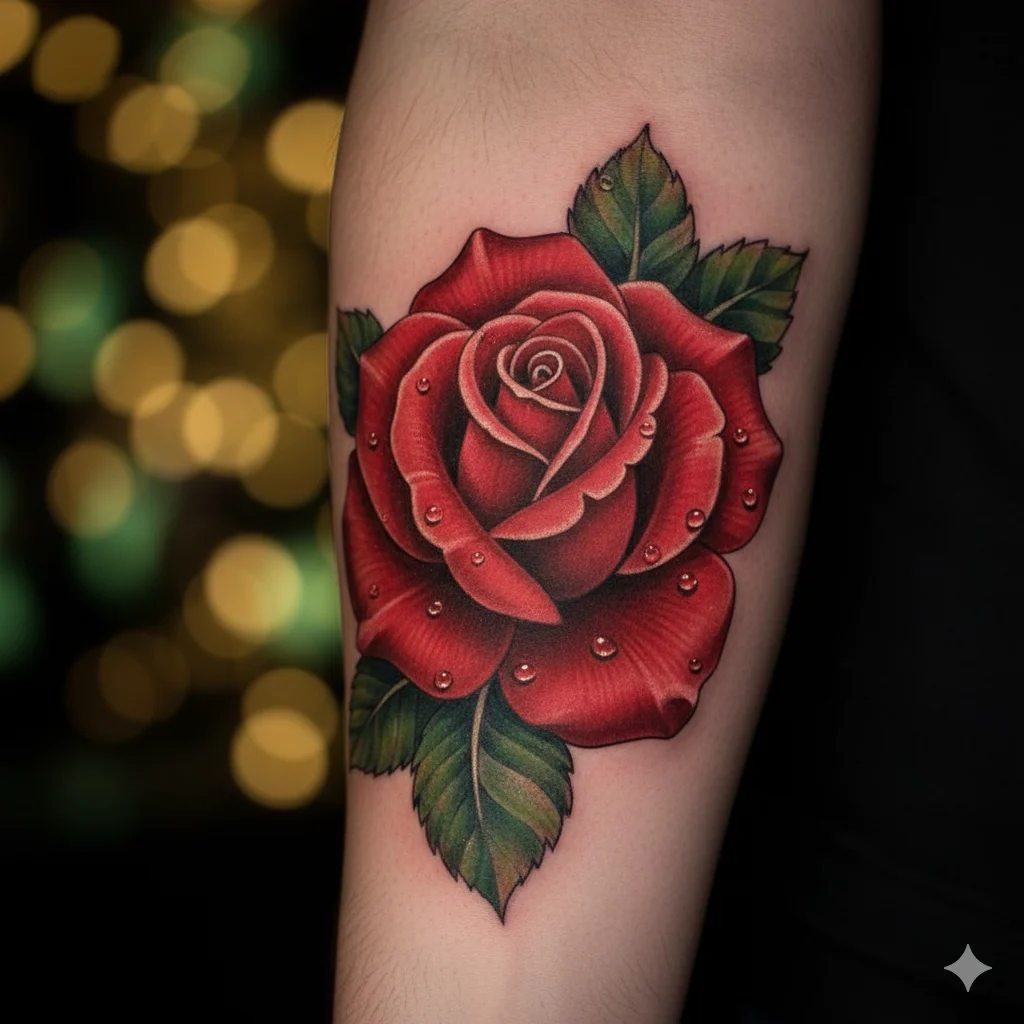
What does a rose tattoo mean? At its core, a rose tattoo symbolizes love, beauty, and passion. However, its meaning is deeply layered, shifting dramatically based on its color, style, and context. Think of it as a text message written in ink—its true message depends on the “emoji” (color) and “formatting” (style) used
You see them everywhere—on a barista’s wrist, peeking from a collar bone, or winding down a guitarist’s arm. A rose tattoo is one of the most iconic and timeless designs in the inking world. But when you spot someone with this intricate bloom, have you ever paused mid-sip of your latte and wondered, “What story is that rose telling?”
The first time I saw a stark, black-and-grey rose on a close friend’s ankle, I assumed it was just a love for gardening. It wasn’t until years later she shared it was a memorial for her grandmother. That’s the secret of the rose tattoo. Like a slang acronym in a group chat, its surface meaning is just the beginning. It’s a deeply personal symbol loaded with history, emotion, and nuance. This article will decode the rich and varied language of the rose tattoo, so you can understand the full story behind the petals.
🧠 What Does a Rose Tattoo Mean in Text? Decoding the Ink’s Language
In the “text message” of body art, a rose tattoo is a complete sentence, rich with adjectives. Its base meaning is universally understood as love, beauty, and passion, rooted in centuries of art, literature, and folklore. But this is just the subject of the sentence. The verb, the tone, and the punctuation come from the details.
For instance, a single, fully bloomed red rose often speaks of romantic love and desire, while a rosebud might signal new love, innocence, or a new beginning. A rose with thorns prominently displayed adds a clause about defense, loss, or the pain that can accompany love. A wilting or dying rose often speaks of grief, lost love, or mortality.
In short: A Rose Tattoo = A Multilayered Symbol of Love & Life = Its specific meaning is defined by its color, state (bud/blooming/dead), and accompanying elements (thorns, skulls, daggers, names).
🎨 The Color Code: What Your Rose’s Hue Reveals
The color of a rose tattoo is its most powerful modifier—it’s the equivalent of using ALL CAPS, a whisper, or a specific tone emoji. Here’s the common color symbolism:
- Red Rose: The classic. Passionate love, romance, desire, and respect. It’s the ultimate symbol of deep, enduring affection.
- White Rose: Purity, innocence, spirituality, and new beginnings. Often chosen for its connection to humility, remembrance, or a fresh start.
- Black Rose: Far from simply “goth.” It symbolizes mystery, the unknown, major change, rebellion, or mourning. It can represent the end of one chapter and the bold step into another.
- Yellow Rose: Friendship, joy, and caring. It’s a platonic symbol of happiness and warmth, free from romantic connotations.
- Blue Rose: The unattainable. Mystery, longing for the impossible, or unique individuality. Since blue roses don’t occur naturally, they represent achieving the extraordinary.
- Purple/Lavender Rose: Enchantment, wonder, and love at first sight. It carries a magical, majestic quality.
- Pink Rose: Grace, gratitude, and admiration. Lighter pinks convey sweetness, while darker pinks express thankfulness.
📱 Where Is the Rose Tattoo Commonly Seen? From Sailors to Social Media
The rose tattoo isn’t confined to one subculture; it’s a universal language spoken across different communities. Its popularity spans:
- ⚓ Traditional & American Traditional (Sailor Jerry Style): Here, the rose is often paired with daggers, skulls, or banners with names. It represents love, beauty, and risk—a sweetheart back home balanced with the danger of life at sea. Tone: Bold, nostalgic, resilient.
- 🎨 Realism & Portraiture: Hyper-detailed, shaded roses that look like photographs. Often used in memorial pieces or to symbolize a person. Tone: Personal, emotional, deeply meaningful.
- 💀 Neo-Traditional & Dark Academia: Roses are intertwined with skulls, books, candles, or clocks, blending beauty with themes of mortality and knowledge. Tone: Philosophical, romantic, gothic.
- ✏️ Fine Line & Minimalist: Single-line roses or simple outlines. Focuses on elegance and personal, understated symbolism. Tone: Modern, subtle, intentional.
- 📱 Social Media & Pop Culture: Popularized by celebrities and influencers, the rose is a staple of aesthetic feeds, often representing self-love, beauty standards, or personal branding.
Is it formal or casual? Like slang, it’s almost exclusively casual and personal. You wouldn’t get a rose tattoo for a corporate dress code; you get it as a permanent piece of your personal narrative.
💬Real “Conversations”: Rose Tattoos in Context
Think of these as snippets of the stories these tattoos tell:
- The Memorial
- Tattoo: A single white rose with “Mom” in a banner underneath.
- The “Conversation”: “This is for my mother. The white rose is for her pure heart and my hope to see her again.”
- The Survival Mark
- Tattoo: A red rose growing through a crack in concrete on a forearm.
- The “Conversation”: “I got this after getting sober. Beauty and life can grow in the hardest places.”
- The Romantic Commitment
- Tattoo: Matching red rose tattoos on a couple’s ring fingers instead of wedding bands.
- The “Conversation”: “Our love is permanent, like this ink. The red rose is our passion for each other.”
- The Self-Love Statement
- Tattoo: A large, vibrant multi-colored rose on a thigh.
- The “Conversation”: “This is for me. After my divorce, it reminded me that I am still beautiful and whole.”
- The Ode to Rebellion
- Tattoo: A black rose with sharp thorns wrapped around a bicep.
- The “Conversation”: “It’s about strength through difficult times and embracing the darker, more resilient parts of myself.”
🕓 When to Get (and When to Reconsider) a Rose Tattoo
✅ When a Rose Tattoo Works Perfectly:
- To honor a deep, abiding love (romantic, familial, or platonic).
- To mark a significant personal transformation or new beginning.
- As a memorial for a loved one.
- To symbolize balance—beauty and pain, love and loss.
- When you connect with the rich, historical symbolism of the rose.
❌ When You Might Want to Pause:
- On a purely impulsive whim without personal meaning (it’s a common tattoo; make it yours).
- If you’re seeking a completely “unique” design with zero mainstream presence.
- As a small matching tattoo in a new relationship (the meaning is deep; ensure the commitment is too).
- If you dislike explaining its meaning; people will ask.
| Context | Example Design | Why It Works |
|---|---|---|
| Memorial Piece | White rose with dates or initials | Symbolizes purity, spirit, and remembrance. |
| Celebrating Love | Red rose intertwined with a partner’s favorite flower | Direct symbol of passion and a personalized combo. |
| Personal Growth | Rosebud just beginning to bloom | Represents potential, new chapters, and becoming. |
| Overcoming Struggle | Rose with thorns, but the flower is bright and forward | Acknowledges past pain but focuses on current beauty. |
🔄 Similar Symbols & Tattoo Alternatives
| Symbol | Core Meaning | When to Choose Over a Rose |
|---|---|---|
| Lotus Flower | Enlightenment, rebirth, rising above adversity. | To emphasize spiritual growth, purity emerging from muddy waters. |
| Peony | Prosperity, good fortune, compassion, feminine beauty. | For a focus on wealth, honor, or a more specifically East Asian symbolism. |
| Daisy | Innocence, loyal love, cheerfulness, simplicity. | For a lighter, more playful, and purely joyful sentiment. |
| Lily | Purity, renewal, transition (especially white lilies for mourning). | Often has a stronger direct association with funerary rites and transition. |
| Sunflower | Adoration, loyalty, positivity, seeking the light. | To symbolize unwavering faith, happiness, and warmth. |
| Cherry Blossom | Beauty of life, its fragility, and the fleeting nature of existence. | To represent the Japanese concept of mono no aware (awareness of impermanence). |
❓ FAQs About Rose Tattoos
What does a rose and dagger tattoo mean?
This classic combo represents the delicate balance between love and pain, beauty and danger, or the idea of “beautiful struggle.” It can symbolize sacrificing for love or the triumph of love over betrayal.
What does a rose and skull tattoo mean?
It’s a powerful memento mori (reminder of death). It symbolizes the coexistence of life and death, beauty and decay, or love that persists even beyond death. It can be a memorial or a statement about accepting mortality.
Are rose tattoos only for women?
Absolutely not. Rose tattoos have a long history in traditionally masculine spaces like sailor and military culture. The meaning transcends gender—it’s about symbolism, not stereotype.
Where is the best place to get a rose tattoo?
It depends on size and personal preference. Large, detailed pieces work well on the thigh, back, chest, or sleeve. Smaller, simpler roses are popular on the wrist, ankle, behind the ear, or finger.
Is a rose tattoo a bad idea?
Not inherently. Its commonality is a strength (artists are very practiced) and a weakness (it’s not “original”). The key is to work with a skilled artist to create a design with personal significance for you, making it unique in its meaning.
🎬 Conclusion:
So, what does a rose tattoo mean? As we’ve seen, it’s a question with a thousand beautiful answers. From the fiery declaration of a red rose to the mysterious allure of a black one, from a single delicate line to a hyper-realistic sleeve, this timeless design holds space for countless stories. Its power lies in its duality—it can be soft and fierce, joyful and mournful, universal and intimately personal.
Ultimately, the truest meaning of any rose tattoo is the one whispered between the skin and the soul of the person who wears it. It’s not just a mark on the body; it’s a chapter in a life, inked in petals and thorns. If you’re considering one, think about the story you want it to tell for decades to come. Make it yours.
Charles Dickens was a legendary English novelist and social commentator known for his timeless storytelling and deep understanding of human nature. His works continue to inspire writers and readers worldwide, shaping literature, culture, and modern narrative craft.