

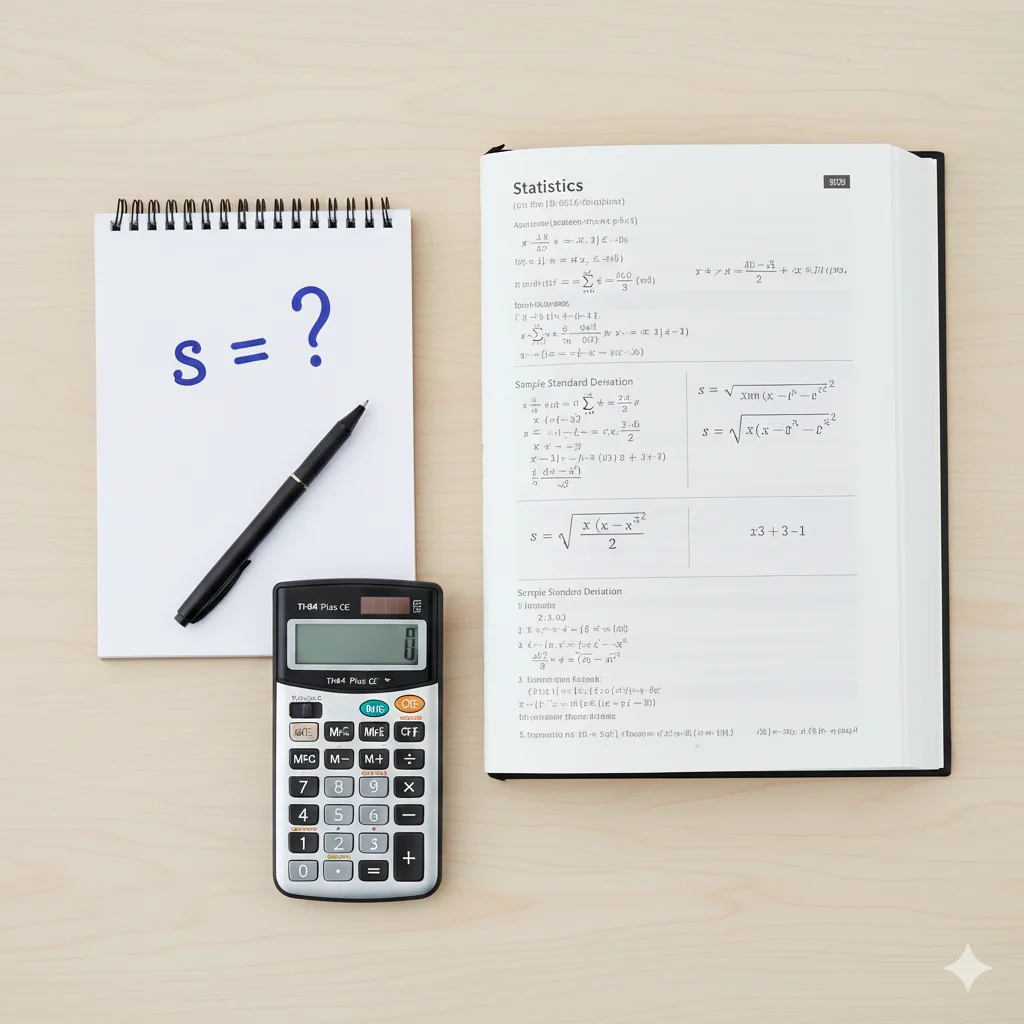
I’ll never forget my first university statistics class. The professor was flying through formulas, and then she nonchalantly wrote a lowercase ‘s’ on the board. My mind immediately went to texting: “What does ‘s’ mean? Sorry? Sure?” I was so lost! If you’ve ever found yourself squinting at a stats textbook or a data analysis report, wondering what this mysterious little letter represents, you’ve come to the right place. Let’s demystify this together.
In statistics, ‘s’ stands for the sample standard deviation. It’s a crucial measure that tells you how spread out the numbers are in a data sample you’ve collected. Think of it as a way to quantify the “average” amount of variation or dispersion from the average (mean) value.
🧠 What Does S Mean in Statistics?
In the world of data and numbers, ‘s’ is not a piece of slang; it’s a fundamental symbol. Its full form is the sample standard deviation. But what does that actually mean?
Imagine you measured the height of five of your friends. You’d have a sample of heights. The mean (average) height tells you the central point, but it doesn’t tell you if everyone is roughly the same height or if there’s one very tall and one very short person. This is where ‘s’ comes in.
The sample standard deviation (‘s’) measures how spread out the data points in your sample are around the sample mean.
A low value of ‘s’ means the data points are clustered tightly around the mean (low variation). A high value of ‘s’ means they are spread out over a wider range (high variation).
Example Sentence: “After calculating the sample standard deviation (s) for the test scores, we saw a high value, indicating that some students scored very high while others scored very low.”
In short: s = Sample Standard Deviation = A measure of data spread in a sample.
📊 S vs. Sigma (σ): What’s the Difference?
This is where many students get tripped up, but it’s a critical distinction for your statistical understanding. You will often see two symbols for standard deviation: ‘s’ and ‘σ’ (the Greek letter sigma).
| Symbol | Represents | Used For | Description |
|---|---|---|---|
| s | Sample Standard Deviation | A subset of a larger population. | An estimate of the population’s variation based on the data you have. |
| σ (Sigma) | Population Standard Deviation | The entire group you want to study. | The true, exact variation of the entire population (often unknown). |
Think of it this way: You want to know the average height of all adults in your country (the population). It’s impossible to measure everyone, so you take a smaller group of 1,000 people (a sample). You use ‘s’ to describe the spread of heights in your sample group. This ‘s’ is your best guess for what ‘σ’ would be for the whole country.
Streaming Mean on TV: Secrets Behind the Scenes Revealed
📱 Where Is the Term “S” Commonly Used?
You’ll encounter this statistical symbol in a variety of data-driven fields and contexts. It’s a cornerstone of quantitative analysis.
- 📈 Academic Research & Scientific Studies: Psychology, sociology, biology—any field that uses data from experiments and surveys relies on ‘s’ to understand their results.
- 💼 Business & Finance: Analyzing sales figures, stock market volatility, or customer behavior data all require understanding variation, which is where ‘s’ is key.
- 🏫 Education: Grading tests, analyzing educational outcomes, and standardized testing reports frequently use standard deviation.
- 🤖 Data Science & Machine Learning: This is a fundamental concept for feature scaling, model evaluation, and understanding data distributions before building algorithms.
- 📊 Quality Control & Manufacturing: Companies use ‘s’ to monitor product consistency. A low standard deviation means their process is stable and predictable.
💻 How to Calculate the Sample Standard Deviation (s)
Understanding the concept is one thing; seeing how it’s calculated can solidify your knowledge. Don’t worry, we’ll break it down step-by-step. The formula for the sample standard deviation is:
s = √[ Σ(xi – x̄)² / (n – 1) ]
It looks intimidating, but it’s just a series of simple steps. Let’s calculate ‘s’ for this small dataset of test scores: [85, 90, 78, 92, 88].
- Find the Mean (x̄): Add all scores and divide by the number of scores.
(85 + 90 + 78 + 92 + 88) / 5 = 433 / 5 = 86.6 - Find the Deviations from the Mean (xi – x̄): Subtract the mean from each score.
85 – 86.6 = -1.6
90 – 86.6 = 3.4
78 – 86.6 = -8.6
92 – 86.6 = 5.4
88 – 86.6 = 1.4 - Square Each Deviation (xi – x̄)²:
(-1.6)² = 2.56
(3.4)² = 11.56
(-8.6)² = 73.96
(5.4)² = 29.16
(1.4)² = 1.96 - Sum the Squared Deviations (Σ(xi – x̄)²):
2.56 + 11.56 + 73.96 + 29.16 + 1.96 = 119.2 - Divide by (n – 1): This is the “sample” part. We use
n-1(degrees of freedom) instead ofnto get a better estimate of the population standard deviation. Here, n=5, so n-1=4.
119.2 / 4 = 29.8 (This value is called the sample variance, s²). - Take the Square Root:
√29.8 ≈ 5.46
So, the sample standard deviation ‘s’ for our test scores is approximately 5.46. This means, on average, the test scores vary from the mean (86.6) by about 5.46 points.
💬 Real-World Examples of S in Action
Let’s see how ‘s’ is used to interpret data in different scenarios.
Example 1: Coffee Shop Order Times
A manager times how long it takes to make 5 coffee orders (in minutes): [2.5, 3.0, 2.8, 5.5, 2.7].
- Interpretation: The mean is 3.3 minutes, but the ‘s’ is high (~1.2). This tells the manager that while the average time is good, the process is inconsistent (likely due to the 5.5-minute outlier), and they need to investigate what caused that delay.
Example 2: Website Load Times
A developer measures the load time (in seconds) for a homepage over a week: [1.1, 1.2, 1.15, 1.1, 1.16].
- Interpretation: The mean is ~1.14 seconds, and the ‘s’ is very low (~0.04). This indicates a highly consistent and reliable user experience, which is excellent for SEO and user retention.
Example 3: Plant Growth with Two Different Fertilizers
A biologist measures the height of plants using Fertilizer A and Fertilizer B.
- Fertilizer A: Mean height = 50 cm, s = 2 cm.
- Fertilizer B: Mean height = 52 cm, s = 8 cm.
- Interpretation: While Fertilizer B produced a slightly taller average plant, its high standard deviation means the results were unpredictable. Some plants grew very tall, others stayed short. Fertilizer A provided more consistent, reliable growth.
✅ When to Use and When Not to Use S
✅ When to Use the Sample Standard Deviation (s)
- When you are working with a sample of data, not the entire population.
- When you need to understand the variability or consistency of your data.
- When you are estimating the characteristics of a larger population.
- When calculating other statistics that rely on it, like confidence intervals and t-tests.
❌ When Not to Rely Solely on S
- When your data set is very small (e.g., n<5), as ‘s’ can be a poor estimate.
- When your data is not normally distributed (e.g., is heavily skewed). In these cases, the interquartile range might be a better measure of spread.
- When you have the data for the entire population; in that rare case, you should use σ.
| Context | Example Phrase | Why It Works |
|---|---|---|
| Academic Paper | “The data showed a mean of 23.4 units with a standard deviation (s) of 4.1.” | Standard, precise, and expected in scientific reporting. |
| Business Report | “Our sales figures have a low standard deviation, indicating consistent performance.” | Professional and clearly communicates stability. |
| Data Science Project | “We normalized the feature by subtracting the mean and dividing by the standard deviation.” | Essential for preparing data for machine learning models. |
🔄 Similar Statistical Measures of Spread
While ‘s’ is the most common, other metrics also describe data spread. Here’s a quick comparison:
| Measure | Symbol/Name | Meaning | When to Use |
|---|---|---|---|
| Standard Deviation | s or σ | Average deviation from the mean. | Most common for symmetric, normal data. |
| Variance | s² or σ² | Average of squared deviations from the mean. | Used in statistical calculations; hard to interpret on its own. |
| Range | Max – Min | The difference between the highest and lowest values. | Quick and dirty estimate of spread, but sensitive to outliers. |
| Interquartile Range (IQR) | Q3 – Q1 | The range of the middle 50% of the data. | Best for skewed data or when outliers are present. |
❓ FAQs About “S” in Statistics
1. Is S variance or standard deviation?
‘s’ is the sample standard deviation. s² (s squared) is the sample variance. Variance is the average of squared differences from the mean, while standard deviation is the square root of variance, bringing it back to the original data units.
2. Why is standard deviation better than variance?
Standard deviation is generally more useful and interpretable because it is expressed in the same units as the original data. For example, if your data is in “cm,” the standard deviation will also be in “cm,” while variance would be in “cm²,” which is harder to understand intuitively.
3. What does a standard deviation of 0 mean?
A standard deviation of 0 means there is zero variation in your data. Every single number in your dataset is exactly the same. There is no spread at all.
4. What is a “good” standard deviation?
There is no universal “good” value. It depends entirely on the context of your data. A standard deviation is “good” or “bad” relative to the mean and the purpose of your analysis. In manufacturing, a low ‘s’ is good for quality. In investing, a higher ‘s’ might mean higher potential reward (and risk).
💎 Conclusion
So, the next time you see that lone lowercase ‘s’ in a statistics problem or a research paper, you can confidently say, “Aha! That’s the sample standard deviation.” It’s not just a letter; it’s a powerful key that unlocks the story behind a set of numbers, telling you not just about the average, but about the consistency, predictability, and variability of the world you’re measuring. From understanding your class’s test performance to analyzing complex business metrics, mastering the meaning of ‘s’ is a fundamental step in your journey toward data literacy.

William Shakespeare was a legendary English playwright, poet, and storyteller whose works have shaped literature for centuries. Known for his timeless plays and sonnets, he continues to inspire writers, artists, and readers around the world with his mastery of language and storytelling.