

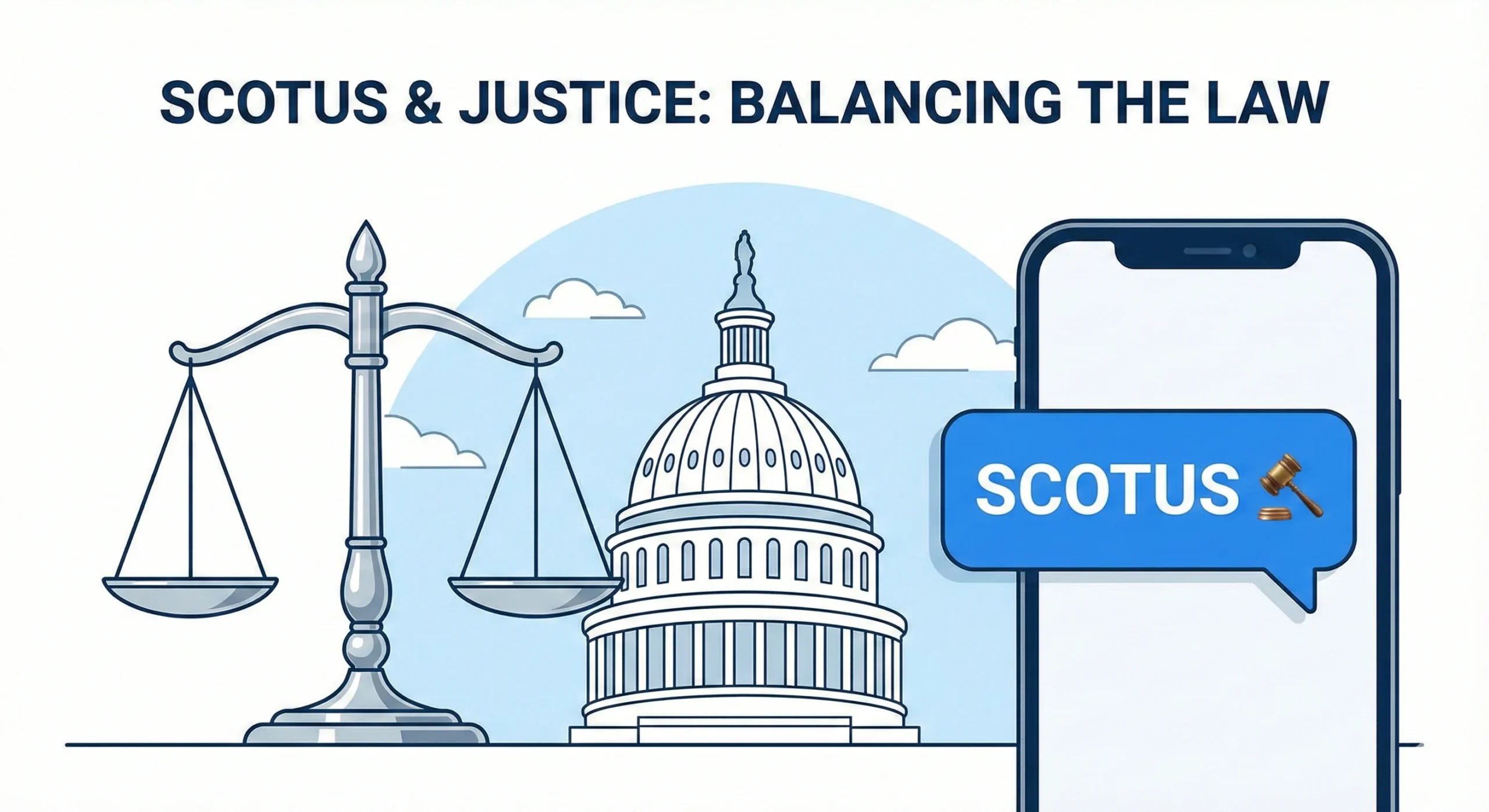
I was scrolling through Twitter (now X) during a major news cycle, and my feed was flooded with takes on the latest “SCOTUS decision.” My friend, who isn’t a politics junkie, texted me: “Everyone’s talking about SCOTUS. Is that some new crypto thing or a rapper?” I had to laugh. It was a genuine moment of confusion that made me realize—not everyone lives and breathes political acronyms! If you’ve ever seen SCOTUS online or in the news and felt a little lost, you’re definitely not alone. It’s one of those terms that insiders use constantly, but can be a total mystery to everyone else.
SCOTUS stands for “Supreme Court of the United States.” It’s a formal and widely recognized acronym used in legal, political, and journalistic contexts to refer to the highest court in the American judicial system.
🧠 What Does SCOTUS Mean in Text and Social Media?
Let’s clear this up right away: SCOTUS is not internet slang. You won’t see your friends texting “scotus 😍” or “brb, scotus.” Unlike acronyms like LOL or IMO, SCOTUS has a very specific, formal meaning. It is the official acronym for the Supreme Court of the United States.
The term originated as a telegraph code in the 19th century, used for brevity and efficiency in communication. It was later popularized in legal circles and by media outlets as a quick, recognizable way to refer to the nation’s top court. When you see SCOTUS, it’s almost always in the context of a major legal ruling, a political discussion, or news about the nine Justices.
Example Sentence: “The SCOTUS ruling on the case will set a national precedent.”
In short: SCOTUS = Supreme Court of the United States = The highest court in the USA.
📱 Where Is the SCOTUS Acronym Commonly Used?
Given its formal nature, you won’t find SCOTUS in casual chats. Instead, it thrives in specific environments where legal and political discourse happens.
- 📰 Journalism & News Media: Major publications like The New York Times, CNN, and Reuters use SCOTUS as a standard term in headlines and articles to save space and sound authoritative.
- 🐦 Social Media (X/Twitter): This is where most people encounter it outside of news sites. Legal experts, politicians, journalists, and politically engaged users employ #SCOTUS to discuss ongoing cases and nominations.
- ⚖️ Legal & Academic Writing: Law reviews, academic papers, and legal briefs use SCOTUS as a standard, formal acronym.
- 🎙️ Political Commentary & Podcasts: Commentators on YouTube, podcasts, and news shows use the term frequently as part of their professional vocabulary.
Tone & Formality: SCOTUS is formal and professional. It is not casual, social-media-friendly in a playful sense, and it is certainly not flirty. Using it correctly signals that you’re discussing serious governmental matters.
💬 Examples of SCOTUS in Conversation
To understand how SCOTUS is used in the wild, here are some realistic examples from different contexts.
Example 1: Social Media Post
User A: The SCOTUS oral arguments today were intense. This could go either way.
User B: I know, I was watching. Justice Jackson’s line of questioning was brilliant.
Example 2: News Headline Chat
A: Did you see the news alert?
B: About the affirmative action case?
A: Yeah, SCOTUS just handed down their decision.
Example 3: Text Conversation
A: My constitutional law class is so intense. We’re analyzing a SCOTUS opinion from the 1950s.
B: Wow, that’s heavy. Is it still relevant today?
A: Incredibly. It’s the foundation for a lot of modern privacy law.
Example 4: Podcast Description
“On this episode, we break down the latest SCOTUS nomination and what it means for the future of the court.”
Example 5: Professional Email
“The team should be aware of the new SCOTUS ruling on digital privacy, as it may impact our compliance protocols.”
🕓 When to Use and When Not to Use SCOTUS
Knowing the right context for SCOTUS is key to using it properly.
✅ When to Use SCOTUS
- In formal writing (reports, academic papers, legal documents).
- When discussing U.S. politics or law on social media.
- In professional emails where the audience understands the term.
- When you want to sound informed about American current events.
❌ When Not to Use SCOTUS
- In casual text messages with friends (unless you know they’ll get it).
- When talking about a state or local court (it’s only for the U.S. Supreme Court).
- In international contexts where people may not be familiar with U.S.-specific acronyms.
- When you need to explain the Supreme Court to someone; use the full name for clarity.
Here’s a quick comparison table for clarity:
| Context | Example Phrase | Why It Works |
|---|---|---|
| Political Twitter Chat | “This SCOTUS decision is a landmark for free speech.” | Concise, professional, and audience-appropriate. |
| Explaining to a Friend | “The Supreme Court just made a huge ruling.” | Uses the full, clear name for better understanding. |
| Formal Legal Brief | “As held in Dobbs v. Jackson, SCOTUS has overturned precedent.” | Standard, expected terminology in the field. |
🔄 Similar Government & Political Acronyms
SCOTUS is part of a family of acronyms used to describe branches of the U.S. government. Here are some other ones you might encounter:
| Acronym | Meaning | When to Use |
|---|---|---|
| POTUS | President of the United States | Referring to the U.S. President in political/news contexts. |
| VPOTUS | Vice President of the United States | Referring to the U.S. Vice President. |
| FLOTUS | First Lady of the United States | Referring to the President’s spouse (or a person in that role). |
| SCOTUS | Supreme Court of the United States | Referring to the highest U.S. court, as discussed. |
| OTUS | Office of the United States | A less common, broader term for the executive office. |
🏛️ A Deeper Dive into the Supreme Court
To truly grasp what SCOTUS is, it helps to understand its role. The Supreme Court is the highest federal court in the United States. Its primary function is to interpret the U.S. Constitution and ensure that laws passed by Congress and the states comply with it. This power, known as judicial review, makes SCOTUS incredibly influential.
👨⚖️ Who Are the SCOTUS Justices?
The Court is composed of nine individuals: one Chief Justice and eight Associate Justices. They are nominated by the POTUS (President of the United States) and must be confirmed by a majority vote in the U.S. Senate. Once appointed, Justices serve for life, a tenure designed to insulate them from political pressures.
⚖️ Why SCOTUS Decisions Matter
The rulings made by SCOTUS are final and set a precedent for the entire nation. This means that their interpretations of the Constitution become the law of the land, binding on all other federal and state courts. A single decision can reshape American society, affecting everything from civil rights and free speech to environmental regulations and business practices.
🔍 How SCOTUS Chooses Its Cases
The Supreme Court has a vast amount of control over its docket. It primarily hears cases through a process called a writ of certiorari, which is essentially a request for the court to review a lower court’s decision. The court only grants this writ if at least four of the nine justices agree to hear the case, a rule known as the “Rule of Four.” They typically select cases that involve important questions about federal law or the U.S. Constitution.
📜 The Most Famous SCOTUS Cases in History
Understanding a few landmark cases illustrates the power of SCOTUS:
- Brown v. Board of Education (1954): Declared state laws establishing separate public schools for black and white students to be unconstitutional, overturning “separate but equal.”
- Roe v. Wade (1973): Established a woman’s legal right to an abortion (this decision was later overturned in 2022).
- Miranda v. Arizona (1966): Led to the “Miranda Rights” that police must recite upon arrest.
- Citizens United v. FEC (2010): Changed campaign finance laws, allowing for greater corporate and union political spending.
❓ FAQs About SCOTUS
1. Is SCOTUS the same as the Supreme Court?
Yes, SCOTUS is simply the acronym for the Supreme Court of the United States. They are the same entity.
2. How do you pronounce SCOTUS?
It’s pronounced as a single word: “skoh-tus.” The ‘SC’ is soft, like in “scope,” not hard like in “scare.”
3. Who is the current Chief Justice?
As of 2024, the Chief Justice of the United States is John G. Roberts, Jr., who was appointed by President George W. Bush and took his seat in 2005.
💎 Conclusion
So, the next time you see SCOTUS trending or pop up in a news headline, you’ll be in the know. It’s not a new slang term or a cryptocurrency, but a powerful acronym representing one of the three pillars of the U.S. government. From its origins as a telegraph code to its modern-day use on social media, SCOTUS remains a concise and vital term for anyone looking to understand American law and politics. Now you can confidently decode the news and impress your friends with your knowledge of what is arguably one of the most important acronyms in the United States.

Ava White is a digital content creator, quotes writer, and communication expert at Jinglas.com. She specializes in crafting simple, engaging explainers on slang, texting culture, and modern online trends to help readers stay informed and confident in the digital world.