
You’re scrolling through a real estate listing or looking at a map, and you see an address for a place you’ve never heard of—but instead of “City, State,” it says something like “Springfield, Anytown County.” No “City of” prefix. You might even live in one and not know it! The term “unincorporated community” pops up, sounding oddly official yet vague. Is it a town? A neighborhood? A legal loophole? If you’ve ever been puzzled by this common geographic and administrative term, you’re not alone. Let’s break down this piece of everyday Americana that affects millions, yet flies under the radar.
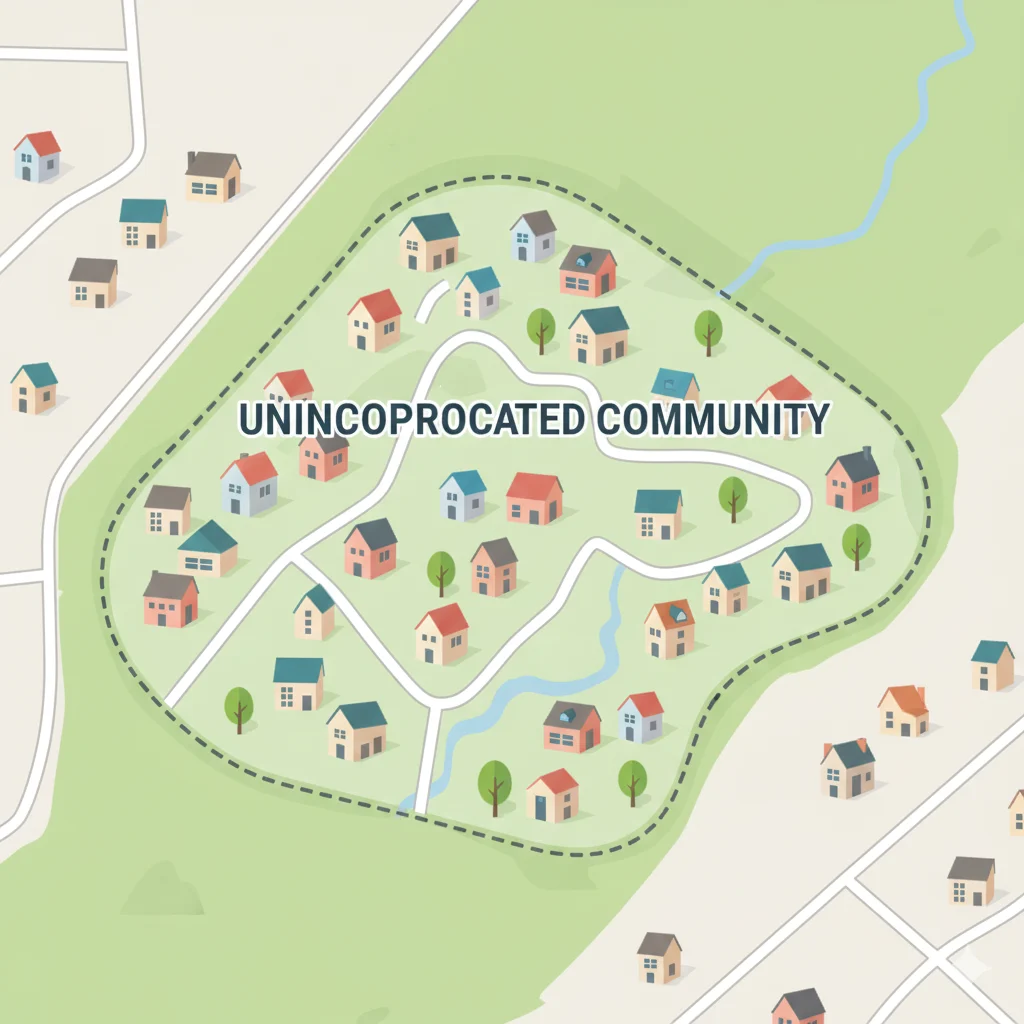
An unincorporated community is a populated area that is not governed by its own local municipal corporation (like a city or town). Instead, it is administered directly by a larger local government, typically a county or parish. It often lacks its own police force, zoning laws, and dedicated public services that incorporated cities provide.
What Does Unincorporated Community Mean in Plain English? 🗺️
Let’s strip away the bureaucratic jargon. Imagine a “community” as any place where people live together—a cluster of homes, maybe a few shops, a post office. Now, “incorporated” means this community has formally organized itself into a self-governing municipality. It has a city charter, a mayor, a city council, and the legal power to create its own local laws (ordinances), provide services like garbage collection and police, and collect specific municipal taxes.
An unincorporated community is the opposite. It has not taken that formal legal step. It exists as a recognizable place with a name (sometimes even a post office), but it operates under the direct governance of its surrounding county. The county sheriff’s department handles law enforcement, county public works handles road maintenance, and county boards make the zoning decisions.
In short: Unincorporated Community = A place with a name and people, but no local city government of its own. It’s run by the county.
Where Do You Find Unincorporated Communities? 📍
Unincorporated areas are everywhere, especially in the United States. You encounter them in:
- Mailing Addresses: Your address might list a well-known place name (e.g., “Holiday, Florida” or “Agoura Hills, California” before incorporation) but your taxes and services come from the county.
- Census Designations: The Census Bureau tracks them as “Census-Designated Places” (CDPs) for data collection, even though they aren’t legal entities.
- Real Estate Listings: Properties may be advertised as being in a desirable community name, but the fine print notes the county jurisdiction.
- Rural and Suburban Areas: They are very common outside of dense urban cores.
- Historical Areas: Many old settlements, crossroads, or railroad stops never formally incorporated.
Examples of Well-Known Unincorporated Communities 🌎
To make this concrete, here are some famous examples—you might be surprised!
- Arlington, Virginia: Yes, the entire urban county containing the Pentagon is unincorporated. It’s a county (Arlington County) that functions like a city but never incorporated as one.
- Paradise, Nevada: Home to the Las Vegas Strip! The Strip is technically in an unincorporated community within Clark County.
- Crystal Lake, Illinois: A large, well-known community that was unincorporated for most of its history before incorporating relatively recently.
- Many “Towns” in Vermont: In New England, “towns” are often the primary form of local government, similar to incorporated places elsewhere, making true unincorporated areas less common, but the concept still applies in county-administered zones.
- Countless rural hamlets and suburbs across America, from Levittown, New York (historically) to Silver Spring, Maryland (before its incorporation).
When Does “Unincorporated Community” Status Matter? ⚖️
Understanding this isn’t just trivia—it affects daily life and big decisions.
✅ The Potential Advantages (When It “Works”)
- Lower Taxes: Often (but not always), there are no additional municipal taxes.
- Less Regulation: Fewer local zoning laws can mean more freedom for property use (e.g., running a small business from home, keeping farm animals).
- Simpler Government: You deal with one layer (county) instead of two (city and county).
❌ The Potential Drawbacks (When It Doesn’t “Works”)
- Limited Services: You might have volunteer fire departments, less frequent road maintenance, limited public transit, and no local police—only county sheriff deputies who may patrol a large area.
- Zoning Challenges: A lack of local control can lead to inconsistent development. A noisy factory could be built next to a neighborhood if the county allows it.
- Identity and Community Voice: It can be harder to advocate for specific community needs (like a new park or traffic light) without a dedicated mayor or city council.
| Context | Example Scenario | Why Status Matters |
|---|---|---|
| Calling 911 | Reporting a burglary in progress. | Response may come from a county sheriff’s substation miles away, not a local police station minutes away. |
| Starting a Business | Wanting to open a café in your neighborhood. | You must comply with county, not city, codes for signage, parking, and health permits. |
| Property Dispute | A neighbor builds a large structure blocking your view. | You appeal to the county planning board, not a local zoning committee. |
| Getting Mail | Your address is “Springfield, Fairview County, 12345.” | The “Springfield” post office serves the area, but “Springfield” is not a governing city. |
How Does an Area Become Incorporated (or Not)? 🏛️
The process varies by state but generally involves:
- Petition: A significant portion of residents must petition for incorporation.
- Feasibility Study: A study determines if the area can generate enough tax revenue to support itself.
- Vote: The residents within the proposed city limits vote on the measure.
- Charter Approval: The state legislature approves a city charter.
Many communities choose not to incorporate to avoid new taxes and bureaucracy. Others incorporate to gain local control over planning and services.
Similar and Related Geographic Terms 🔄
| Term | Meaning | Key Difference |
|---|---|---|
| Incorporated City/Town | A self-governing municipality with its own local government. | Has its own city government, police, laws, and taxes. |
| Census-Designated Place (CDP) | A statistical area defined by the U.S. Census Bureau for data gathering. | A statistical designation, not a legal/government one. An unincorporated community is often a CDP. |
| County | An administrative subdivision of a state, the primary government for unincorporated areas. | The larger entity that governs unincorporated places within it. |
| Municipality | A broad term for any incorporated city, town, village, or borough. | The umbrella category that unincorporated communities are not part of. |
| Hamlet/Village | Informal or historical terms for a small settlement. In some states (like NY), “village” can be an incorporated municipality within a town. | Often used interchangeably with “unincorporated community,” but can have specific legal meanings in certain states. |
FAQs
Do I pay taxes if I live in an unincorporated community?
Yes, but primarily to the county, state, and federal government. You usually do not pay a separate municipal income or property tax. However, you may pay county taxes for services.
Who provides water and sewer?
It varies. It could be a county utility, a private well and septic system, or a special small district created just for that service.
Can an unincorporated community become a city?
Absolutely. Through the process of incorporation, as described above. This often happens when population grows and residents desire more localized control.
Is “unincorporated” the same as “rural”?
Not necessarily. While many rural areas are unincorporated, there are also dense, suburban unincorporated communities (like Silver Spring, MD, pre-1948). “Unincorporated” is a legal status; “rural” is a description of density and land use.
How do I know if I live in one?
Check your property tax bill or voter registration. If your address lists only a county and no city, or if your services (trash, police) are clearly labeled as county services, you likely do.
Conclusion:
So, what does “unincorporated community” mean? It’s the label for the vast, fascinating gray area between formal city limits and open countryside. It represents a choice—sometimes intentional, sometimes historical—to forgo a layer of local government in exchange for a different mix of freedom, cost, and service. It’s why two neighbors across the street from each other might have different trash pickup days, different zoning rules, and call a different office to complain about a pothole. Understanding this concept is key to understanding how American geography, governance, and daily life are woven together. The next time you see that term on a map or address, you’ll see not just a place, but a living example of local democracy in action—or, in this case, a conscious choice to keep things at the county level.

Ava White is a digital content creator, quotes writer, and communication expert at Jinglas.com. She specializes in crafting simple, engaging explainers on slang, texting culture, and modern online trends to help readers stay informed and confident in the digital world.