
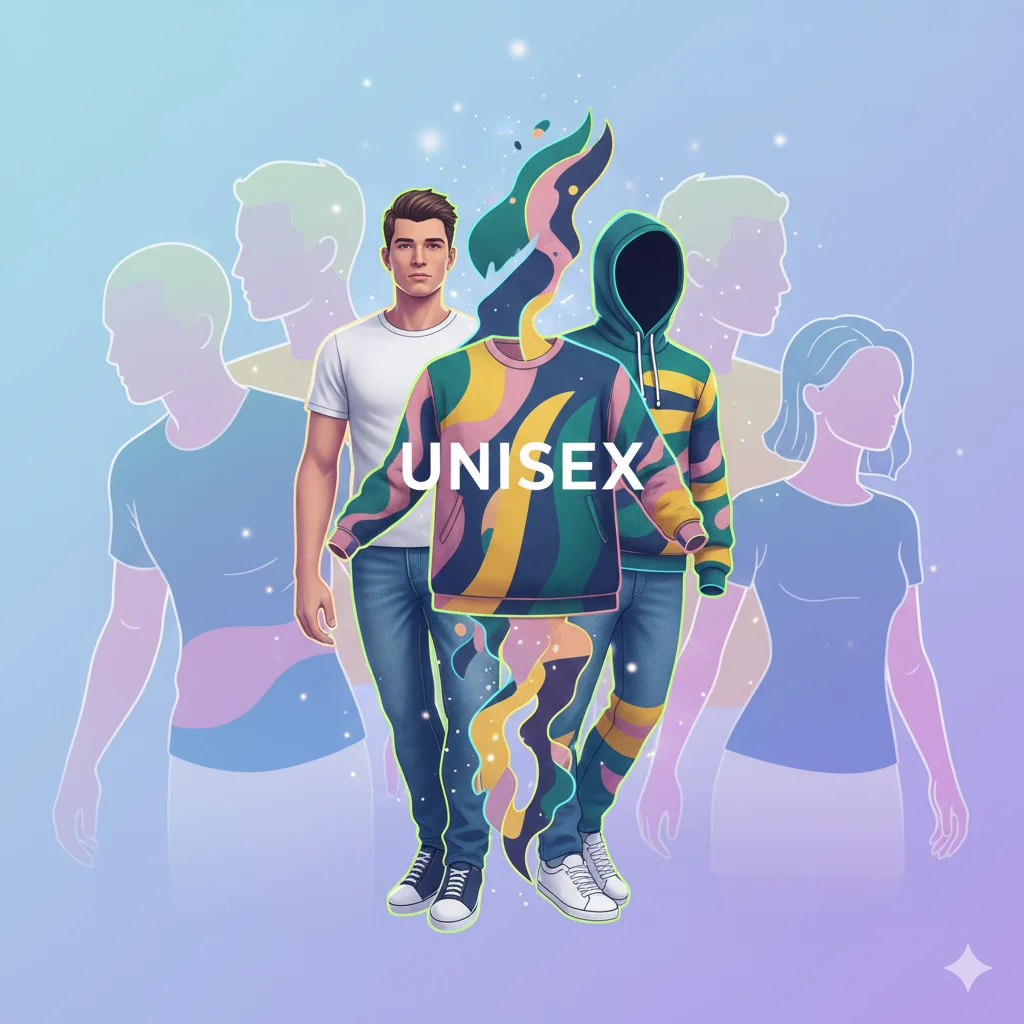
Unisex means something—typically clothing, products, spaces, or services—designed to be suitable and used by all genders, not specifically for men or women
Picture this: you’re shopping online for a cool graphic tee. You find the perfect design, but then you hit the sizing dropdown. Instead of the usual “Men’s” and “Women’s,” the only option is “Unisex.” You pause. Does that mean it runs big? Small? Is it a boxy “men’s” fit marketed to everyone? If you’ve ever felt a flicker of confusion seeing that label, you’re not alone. The term is everywhere—from hoodies and fragrances to hair salons and bathrooms—but its true meaning often gets lost in translation.
Is it just a marketing buzzword, or does it represent a genuine shift toward inclusivity? Let’s unravel the threads of this common but sometimes misunderstood term, moving beyond the simple dictionary definition to see what “unisex” really signals in our world today.
What Does Unisex Mean? Breaking Down the Basics
At its core, unisex is a combination of the prefix “uni-” (meaning one or same) and “sex” (referring to biological sex). The term literally means “one sex,” but its practical meaning is “not distinguished or differentiated by sex or gender.”
A unisex item is intentionally designed to eliminate gender-specific cues, creating something that is universally applicable. It’s not about making a “men’s” product for women or vice-versa; it’s about creating a third, neutral category from the ground up. The goal is to focus on function, style, or utility without gender being a factor in its design or intended user.
In short: Unisex = For Any Gender = Design Without Gender Boundaries.
The Evolution of Unisex: Beyond Just Clothing
The concept isn’t as modern as you might think. While the word gained massive popularity in the 1960s and 70s during fashion’s gender-blurring revolution, the idea has deeper roots. However, its meaning and cultural significance have evolved dramatically.
- Mid-20th Century: “Unisex” often meant borrowing from menswear (like pants, blazers, short hair) for women, challenging strict feminine norms.
- Late 20th Century: It became a marketing term for products like shampoos or colognes (“unisex fragrance”) that avoided floral or musky stereotypes.
- 21st Century & Today: The term has matured. Now, it’s closely linked with inclusivity, neutrality, and the rejection of the gender binary. It’s less about androgyny and more about creating options that don’t force a gender identity onto the user. This shift aligns with a broader societal understanding of gender as a spectrum.
Where Is Unisex Commonly Used? (More Than Just T-Shirts!)
You’ll encounter the unisex label across many aspects of daily life. Here’s where it’s most popular:
- 👕 Fashion & Apparel: This is the biggest arena. Think band merch, company swag, basic tees, hoodies, jeans, sneakers, and accessories like watches or backpacks. The fit is often (but not always) based on traditional menswear sizing for simplicity.
- 🧴 Beauty & Grooming: Brands are moving away from “for him” and “for her.” Skincare, haircare, fragrances, and deodorants are increasingly marketed as gender-neutral, focusing on skin type or scent profile instead.
- 🛋️ Product Design: Furniture, gadgets, and stationery often boast a unisex aesthetic—think minimalist, neutral colors, and clean lines meant to appeal universally.
- ✂️ Services: Unisex hair salons, clothing stores, and spas cater to all clients without gender-based pricing or service separation.
- 🚻 Public Spaces: Unisex or gender-neutral bathrooms provide safe, inclusive facilities for everyone, including transgender, non-binary, and gender-nonconforming individuals, as well as parents with children.
Unisex vs. Gender-Neutral vs. Genderless: What’s the Difference?
These terms are often used interchangeably, but subtle differences are emerging in modern discourse. Here’s a quick comparison:
| Term | Core Focus | Nuance & Usage |
|---|---|---|
| Unisex | Suitability for All | The most established term. Implies something is designed to be worn/used by both individuals equally. Can sometimes feel like a “one-size-fits-both-genders” approach. |
| Gender-Neutral | Active Inclusion | Often preferred today. Emphasizes the conscious avoidance of gender association. It feels more intentional about inclusivity, especially for non-binary people. |
| Genderless | Absence of Gender | The most progressive term. Suggests that the concept of gender is irrelevant to the design or purpose. Common in avant-garde fashion aiming to dismantle gender norms entirely. |
Think of it this way: A unisex t-shirt is cut to fit various bodies. A gender-neutral clothing line avoids “men’s/women’s” sections altogether. A genderless fashion collection presents clothing purely as form and fabric, divorced from gender identity.
Examples of Unisex in Real-World Contexts
Let’s move from theory to practice. How does “unisex” play out in everyday scenarios?
- Online Shopping:
- Customer: “I love this sweatshirt! Is the fit for men or women?”
- Brand Chatbot: “All our apparel is unisex! We recommend checking the size guide for measurements to find your best fit.”
- Planning an Event:
- Friend A: “What’s the dress code for the wedding?”
- Friend B: “It’s cocktail attire, but they said it’s unisex—so wear what makes you feel fantastic!”
- Discussing Gifts:
- Text Message: “Getting a gift for my roommate. They have pretty unisex taste—thinking a nice leather journal or a minimalist plant pot.”
- Designing a Space:
- Architect: “For the new studio apartments, we’re installing unisex bathroom fixtures and using a neutral color palette to appeal to a broad range of tenants.”
- Beauty Shopping:
- Sales Associate: “This sandalwood and bergamot scent is one of our most popular unisex fragrances. It’s fresh and earthy on everyone.”
When to Use and When to Avoid the “Unisex” Label
Understanding the context is key to using the term appropriately.
✅ When the Term “Unisex” Works Well:
- Describing Product Design: When explaining a garment, gadget, or product made for a universal audience.
- Promoting Inclusivity: When a brand or service wants to explicitly state it welcomes all genders.
- Simplifying Options: When offering one streamlined product (like event merch) to avoid production complexity.
- In Casual Conversation: When generally describing something that isn’t gender-specific.
❌ When “Unisex” Might Miss the Mark:
- When “Gender-Neutral” is More Accurate: If the goal is specifically to be inclusive of non-binary and transgender individuals, “gender-neutral” is often the more modern and conscious choice.
- As an Excuse for Poor Fit: If a “unisex” item is just a men’s item rebranded and doesn’t actually fit diverse body types well.
- In Highly Specific Medical/Legal Contexts: Where precise, biological sex-based language is necessary.
- When It Erases Choice: Some people enjoy gender-specific styling. Unisex should be an option, not a mandate that removes other choices.
The Impact and Criticism of Unisex Design
The rise of unisex is powerful, but it’s not without its critiques.
- The Positive Impact:
- Inclusivity: Makes spaces and products safer and more welcoming for LGBTQ+ communities.
- Freedom of Expression: Allows people to choose products based on personal style, not gender rules.
- Sustainability: Streamlined, shared product lines can reduce overproduction and waste.
- Common Criticisms:
- The “Boxy” Problem: In fashion, “unisex” often defaults to a masculine-shaped fit, ignoring the diverse curves and proportions of different bodies.
- Marketing Ploy: Sometimes it’s just a label slapped on without genuine design thought behind it.
- Loss of Specificity: For some, gender-specific products (like certain cuts of jeans) are preferred for their tailored fit.
FAQ About “Unisex”
Is unisex the same as androgynous?
Not exactly. Androgynous describes a style or appearance that blends or neutralizes masculine and feminine characteristics. Unisex describes the intended audience or design purpose of an item.
What does a unisex fit feel like?
Typically, it’s straighter, with less tailoring at the waist or chest. Sleeve and torso lengths often follow a standard (usually men’s) sizing chart. Always check the specific brand’s size guide.
Are unisex clothes just for non-binary people?
No, they are for anyone. While they are a vital option for non-binary and gender-nonconforming individuals, anyone who likes the style or fit can wear unisex clothing.
Why are most unisex clothes gray, black, or white?
Neutral colors are an easy way to avoid gendered color stereotypes (like pink vs. blue). However, modern unisex/gender-neutral design is increasingly embracing all colors.
Is “unisex” an outdated term?
It’s still widely used and understood, especially in commerce. However, in social and design circles focused on the forefront of inclusivity, “gender-neutral” is often the preferred modern terminology.
Conclusion
So, what does unisex mean? It’s far more than a tag on a t-shirt. It represents a move toward inclusion, simplicity, and freedom. It challenges the ingrained idea that everything from our scents to our sweaters must be categorized as “for him” or “for her.”
While the term has its limitations—sometimes serving as a band-aid for poor design—its cultural power is undeniable. It opens a door to a world where personal preference trumps prescribed gender norms. The next time you see that “unisex” label, see it not as a confusing sizing quirk, but as a small invitation: an invitation to choose what works for you, based on nothing but your own comfort and style.

William Shakespeare was a legendary English playwright, poet, and storyteller whose works have shaped literature for centuries. Known for his timeless plays and sonnets, he continues to inspire writers, artists, and readers around the world with his mastery of language and storytelling.